

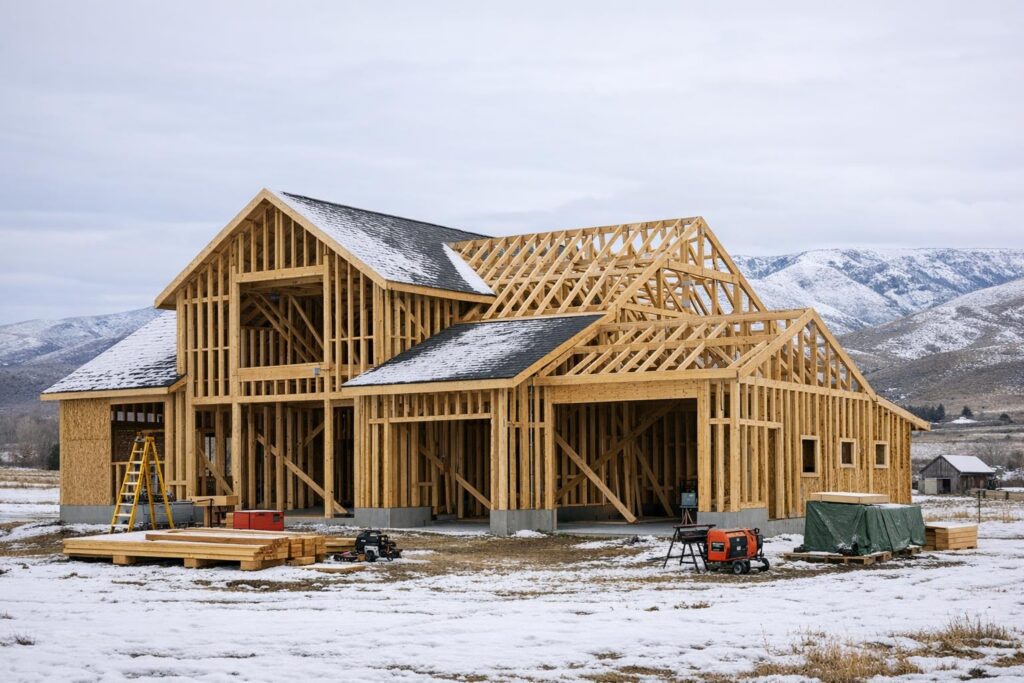
Strong buildings start with the right design loads—especially in Southern Idaho’s snow and wind
This guide breaks down what snow load and wind load mean, how they’re determined, and what smart homeowners can do early to keep their custom barndominium (wood-frame) design smooth from permitting to final build.
Snow load vs. wind load: what they actually do to a barndominium
Wind load (pressure + suction): pushes on walls and can pull up on roof edges/corners. Wind load heavily influences roof-to-wall connections, hold-downs, shear walls, bracing, and fastening schedules—especially on large, simple roof planes common in barndominium layouts.
Why “Boise snow load” isn’t a one-number answer
Roof snow load (Pf): what the roof is actually designed for after applying code factors (roof slope, exposure, thermal conditions, importance/risk category, drift, and more). FEMA and ASCE-based guidance distinguishes these clearly because the roof load is not simply the same as the ground load.
Key takeaway: your roof design snow load depends on your exact roof geometry and site. Big open spans, multiple rooflines, or a taller “shop” volume next to a lower “living” roof can create drift conditions that require additional design attention beyond a single uniform number.
Did you know? Fast facts Idaho builders watch for
Step-by-step: how to get snow load & wind load right (without overcomplicating it)
1) Start with your exact site (address + elevation + surroundings)
2) Decide early: roof shape, slope, and any “step-down” rooflines
3) Make sure your truss/framing package matches the engineered loads (not just a generic “roof load”)
4) Ask for connection details that match Idaho wind realities
5) Keep permit review smooth: document your design criteria on the plans
Quick comparison table: what changes snow & wind loads on a Boise-area build
| Design factor | Mostly affects | Why it matters for barndominiums |
|---|---|---|
| Elevation / microclimate | Snow | Idaho snow can vary sharply with elevation; using a “city average” can miss the mark. |
| Roof slope & shape | Snow + Wind | Snow sliding/drifting and wind suction at edges change with geometry. |
| Exposure category (open fields vs neighborhoods) | Wind | More exposure can increase pressures and uplift demands. |
| Building volume changes (tall shop + low living wing) | Snow | Creates drift zones where snow piles up at roof transitions. |
Boise & Southern Idaho angle: what locals should watch for
But the moment you move across the Treasure Valley—or start building toward foothills, benches, or higher-elevation communities—snow load assumptions can change. Some jurisdictions also publish minimum roof design snow loads even when ground snow appears lower, which is why it’s smart to confirm the governing criteria with your local building department and your project’s engineer/designer.
For wind, local city documents can reference specific wind assumptions for certain building types (like small accessory structures), but custom homes and barndominiums should still be evaluated using the correct risk category, exposure, and roof geometry for the actual site.